
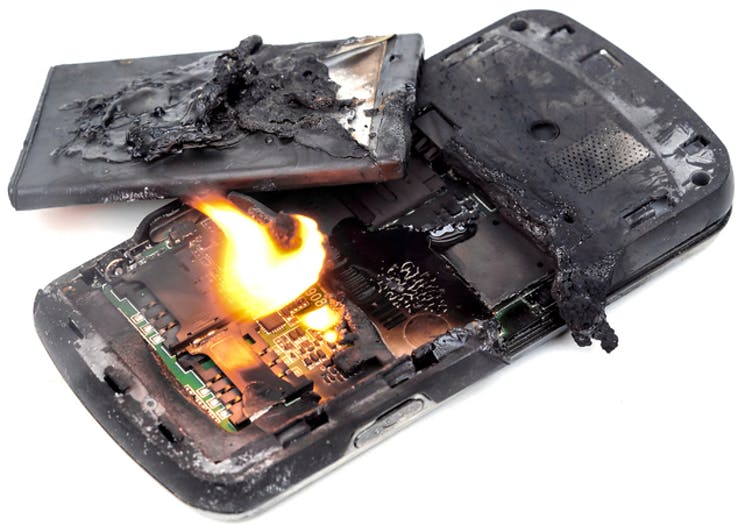
There has again been further media coverage of batteries catching fire causing substantial loses.
Now even large companies like Samsung don’t always get it right when it comes to battery technology. I am a Samsung Note user myself and the Note 7 battery fiasco was damaging to Samsung’s reputation at the time. Airlines would not permit them on board aircraft and for understandable reasons. Obviously all manufactures want the highest capacity for the smallest footprint and Samsung took it a step too far with the Note 7. Samsung seem to have worked out a ratio for power capacity density that is now safe.
Lithium batteries are though now fitted to most portable devices not just phones due to the power density and number of charge cycles they offer. So the danger from these batteries is all around us.
Even a lithium battery manufactured by a reputable manufacturer which is safe to use under normal conditions can cause a fire if it is handled incorrectly.
You may notice labels on batteries indicating that they should not be pierced or over heated. Simply this is because a battery is made up of a number of conductive layers. These layers are insulated from one another and the piercing or melting of the insulating layers causes a short. Current then flows between the layers creating more heat and this leads to a runaway reaction destroying the battery until all the chemical energy is expended. This rapid release of energy is what causes a fire. While most of us are unlikely to skewer our portable devices on purpose excess heat can be caused by seemingly innocuous practices like using the wrong charger, charging in direct sunlight or on a radiator.
Why are these accidents happening more frequently? Most phones are now glued together and often the batteries will last the 18 months until we are offered our next upgrade. However some devices do still have removable batteries and we may well need extras or to replace a dead one and not all replacements are made equal.
While not all lithium batteries are made in China a great deal are, especially after market versions. Most of us know that buying such things after market is probably not a great idea. However we all want the cheapest deal on eBay and unfortunately some manufacturers are quite happy to put fake labels on batteries made from inferior materials. These labels will have a CE mark on them and most of us would be hard pushed to spot the difference. Chargers can also be hazardous, many of the safety design features are expensive and components such as MOVs, safety diodes and even fuses are sometimes omitted to save money.
EBay takes very little responsibility when vendors are selling these products. Often the item you buy might sound like it is coming from a professional company but often it is some guy selling from his spare bedroom. From my understanding when a potentially dangerous product is identified they may remove the listing but they will not contact customers who have already purchased them to warn that they may be unsafe.
How can we avoid these accidents?
My first piece of advice is to buy from a manufacturers you have heard of that is an established brand. They will have a quality control process in place to ensure that the components used in manufacturing are the same as the design specification which will have been rigorously tested. Slightly off topic but in the course of carrying out Portable Appliance Testing every year we come across equipment which doesn't even have an earth connection. You would like to think that the guy that made it was having an off day and quality control missed it but in many cases these things are omitted or cheaper parts substituted to save money. If something looks like the branded item but is half the price likely it is not going to be built the same on the inside.
Buy from a known supplier, this is going to be more expensive however you are much less likely to be supplied with counterfeit and possibly dangerous products. If anything does go wrong and it was not user error you will have some redress with them.
Use the charger that came with the product, if you need a new charger buy a genuine one from a known supplier.
If your battery is swelling or gets very hot while charging these are warning signs that something is wrong with the battery, charger or both. Use this warning and replace before the accident occurs.
Finally once you have finished with your old battery dispose of it safely. It should not be put in the bin as if it is compacted in a dust cart it is possible the dust cart could catch fire. There have been several reports of this happening as well recently. Batteries should be taken to your local Household Waste Recycling Site for safe disposal.
If you would like any help or advice sourcing batteries for your professional AV equipment please get in touch with us and we will be happy to supply you with manufacturer original or verified third party components.